About the Society

The Indian Society of Arachnology came into being because they realized that there was a gap in the academic study and documentation of arachnids in India. Insects are certainly studied in academia and in conservation circles. Unfortunately, spiders, scorpions, mites, and other groups were quite often left out. This is despite the fact that they play a vital ecological role. The society came in to fill in the gap by providing structure, collaboration, and profile to arachnological research in India.
The history, the reasons given for the founding of the society, and those who guided towards its development in the early years are mentioned here. Knowing the background sheds much light on the realization that societies should concentrate on documentation, truth, and long-term knowledge building as opposed to visibility.
Origins and Early Development
The society was established during a period when interest in Indian biodiversity was expanding beyond large mammals and birds. Researchers working independently on spiders and other arachnids often faced isolation, limited funding, and a lack of shared reference material. The formation of a dedicated society created a platform for these researchers to connect, exchange findings, and standardise methods of study and documentation.
In its early years, the society focused on building a basic framework for collaboration. Meetings, informal workshops, and shared field surveys helped establish common goals. These early efforts laid the groundwork for later research initiatives and educational outreach, even though resources were limited and participation was largely voluntary.
The Founder and Founding Vision
The founder of the Indian Society of Arachnology was driven by a strong belief that arachnids deserved the same scientific attention as other animal groups. With a background in biological research and fieldwork, the founder recognised that spiders and related species were both ecologically critical and scientifically underrepresented in India.
The founding vision centred on three ideas: accurate documentation, open knowledge sharing, and conservation informed by science rather than fear or misinformation. From the beginning, the society aimed to create reliable records that could be used by researchers, educators, and policymakers alike.
Growth and Institutional Recognition
Over time, the society gained recognition within academic and conservation circles. Membership expanded to include university researchers, independent naturalists, and students. This growth allowed for more organised research projects and the gradual development of reference materials relevant to Indian arachnids.
Institutional recognition also brought new responsibilities. The society began to emphasise ethical research practices, data transparency, and collaboration with other scientific organisations. These values continue to shape its work today and are reflected throughout this archive.
Why Arachnology Matters
Arachnology is commonly terrible misapprehended or trivialized due to cultural fear and misinformation about spiders and their relationship to other species. Primarily, spiders and all arachnid species have a controlling power in the balance of the ecosystem; they are predators, prey, and indicators of environmental health. For practical conservation and land management decisions to be taken, understanding their role is critical.
This phase of the text demonstrates why arachnology is not only relevant to scientists but also to agricultural, public health, and biodiversity policy. It discusses the broader nitty-gritty of the studies of arachnids in being fitted into the complex and rapidly changing environments of India.
Ecological Importance of Arachnids
Arachnids play a major role in controlling insect populations, including agricultural pests. Spiders alone consume vast numbers of insects, reducing the need for chemical pest control in many ecosystems. This natural regulation supports crop health and contributes to more sustainable agricultural practices.
Beyond pest control, arachnids are integral parts of food webs. They serve as prey for birds, reptiles, and mammals, linking multiple trophic levels. The loss or decline of arachnid populations can therefore have cascading effects throughout an ecosystem.
Indicators of Environmental Change
Because many arachnid species are sensitive to habitat disturbance, pollution, and climate variation, they can serve as valuable indicators of environmental change. Shifts in species distribution or abundance often reflect broader ecological stress before more visible impacts occur.
In India, where habitats range from rainforests to deserts, monitoring arachnid populations provides insight into how ecosystems respond to development and climate pressures. Arachnological research helps identify areas at risk and supports evidence-based conservation planning.
Challenging Fear and Misconceptions
Public perception of arachnids is often shaped by fear rather than fact. Many species are wrongly assumed to be dangerous, leading to unnecessary killing and habitat destruction. Arachnology helps replace myths with scientific understanding.
By documenting species behaviour, venom properties, and ecological roles, researchers can clarify which species pose real risks and which do not. This knowledge supports coexistence and reduces harm driven by misunderstanding.
Research Focus and Areas of Interest
Research conducted or supported by the Indian Society of Arachnology spans a wide range of topics, reflecting the diversity of arachnids themselves. Rather than focusing narrowly on a single group, the society encourages comprehensive study across species, regions, and disciplines.
This section outlines the main research areas that define the society’s work. Together, they form a structured approach to understanding arachnid life in India and contributing meaningful data to global science.
Taxonomy and Species Documentation
One of the society’s core research priorities is taxonomy, including the identification and description of species. India is home to thousands of arachnid species, many of which remain undocumented or poorly described. Accurate taxonomy is the foundation of all further research and conservation work.
Field surveys, specimen collection, and comparative analysis are used to clarify species boundaries and resolve classification challenges. These efforts help prevent misidentification and ensure that conservation decisions are based on reliable data.
Behaviour and Ecology
Understanding how arachnids interact with their environment is essential for interpreting their ecological role. Research into behaviour, hunting strategies, reproduction, and habitat use provides insight into how species survive and adapt across diverse landscapes.
In India’s varied ecosystems, behavioural studies reveal how species respond to seasonal changes, human disturbance, and resource availability. This knowledge contributes to broader ecological models and supports habitat-specific conservation strategies.
Venom Studies and Human Interaction
While only a small number of arachnids pose medical risks to humans, venom research remains an important area of study. Accurate information about venom composition and effects helps guide medical response and public education.
Research in this area also has potential applications beyond medicine, including biotechnology and pharmacology. Documenting venom properties requires careful ethical standards and collaboration with medical professionals.
Conservation and Habitat Assessment
Arachnid conservation is closely tied to habitat preservation. Research often focuses on assessing habitat quality, fragmentation, and land-use change. By understanding where species occur and what conditions they require, conservation priorities can be identified more clearly.
This work supports broader biodiversity initiatives and helps ensure that arachnids are considered in environmental impact assessments and conservation planning.
Education and Knowledge Sharing
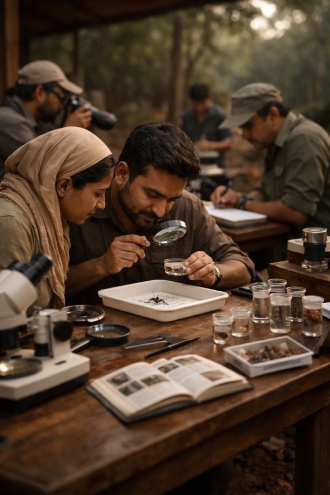
Education is a central pillar of the Indian Society of Arachnology’s mission. Scientific knowledge has limited value if it remains inaccessible to students, educators, and the wider public. The society therefore places strong emphasis on sharing information in clear, accurate, and responsible ways.
This section outlines how knowledge is disseminated and who it is intended to reach. Education efforts aim to support formal research while also encouraging curiosity and informed interest among non-specialists.
Academic Support and Student Engagement
The society provides guidance and reference material for students interested in arachnology and related fields. This includes support for academic projects, field methods, and species identification. By offering a structured entry point, the society helps reduce barriers for new researchers.
Student engagement is seen as an investment in the future of the field. Encouraging early interest helps build long-term capacity for research and conservation in India.
Workshops and Training Activities
Training activities focus on practical skills such as field survey techniques, ethical specimen handling, and data recording. These workshops help standardise research practices and improve data quality across studies.
Training also fosters collaboration between experienced researchers and newcomers. Shared learning environments strengthen the research community and encourage consistent scientific standards.
Public Awareness and Outreach
Public education initiatives aim to increase understanding of arachnids beyond academic circles. Outreach materials and talks focus on ecological roles, safety, and coexistence rather than sensationalism.
By addressing common fears with factual information, outreach efforts contribute to more informed attitudes toward arachnids and biodiversity in general.
Key Educational Activities
- Field-based identification sessions for students and researchers
- Introductory resources explaining arachnid biology and ecology
- Guidance on ethical research and documentation practices
- Public lectures focused on reducing misinformation and fear
Arachnid Diversity in India
India’s geography and climate create ideal conditions for arachnid diversity. From tropical forests and grasslands to arid regions and high-altitude ecosystems, each habitat supports distinct species assemblages. Documenting this diversity is a central goal of arachnological research.
This section provides an overview of the scale and significance of arachnid diversity in India and explains why continued documentation is essential for science and conservation.
Regional Variation and Endemism
Many arachnid species in India are highly localised, with distributions limited to specific regions or habitats. This endemism reflects long evolutionary histories shaped by geography and climate.
Understanding regional variation helps identify biodiversity hotspots and areas of conservation concern. It also highlights the risk of habitat loss, as localised species are often the most vulnerable to environmental change.
Spiders and Other Arachnid Groups
While spiders are the most widely recognised arachnids, India is also home to scorpions, mites, ticks, harvestmen, and lesser-known groups. Each plays a distinct ecological role and requires specialised study methods.
Comprehensive documentation ensures that research does not focus narrowly on a single group at the expense of others. A balanced approach provides a fuller picture of ecosystem function.
Challenges in Documentation
Documenting arachnid diversity presents practical challenges, including limited funding, difficult terrain, and seasonal accessibility. Many species are small, cryptic, or active only during specific times, making detection difficult.
Despite these challenges, consistent fieldwork and collaboration continue to improve knowledge. Archival efforts such as this site help preserve findings and prevent loss of information over time.
Future Directions for Biodiversity Research
Future research aims to integrate traditional field methods with newer tools such as geographic analysis and long-term monitoring. These approaches can improve understanding of population trends and environmental pressures.
By building on existing data and maintaining accurate archives, arachnological research in India can continue to inform conservation and ecological science.
Conservation Status and Emerging Threats
Although many arachnid species in India have not yet been formally assessed for conservation status, growing evidence suggests that habitat loss, pesticide use, and climate change are having measurable impacts. Urban expansion and agricultural intensification reduce suitable habitats, while chemical exposure affects both prey availability and arachnid survival directly. Because arachnids are often absent from mainstream conservation assessments, declines may go unnoticed until populations are severely reduced. Improved documentation and long-term monitoring are therefore essential to understanding risk levels and integrating arachnids into broader conservation frameworks.
Archival Purpose and Long-Term Value
This website functions as an archival record rather than a news platform or promotional outlet. Its purpose is to preserve information that is often scattered across academic papers, field notes, and personal research collections. Arachnological knowledge is especially vulnerable to loss because much of it is produced by small research groups or individuals working outside large institutions. Without deliberate preservation, valuable observations and data can disappear over time.
By bringing historical context, research focus, and educational activity into one place, the archive supports continuity in the field. It allows future researchers to trace how knowledge has developed, identify gaps in documentation, and build upon earlier work without repeating it. For students and educators, the archive offers a stable reference point grounded in verified information. In this way, the site contributes to scientific memory, ensuring that the study of India’s arachnid diversity remains cumulative, transparent, and accessible across generations.
Preserving Knowledge for the Future
The primary aim of the present archive is to sustain an understanding that is long-standing, well-constructed, and deeply rooted. It will document the Society of Indian Arachnology and the vast context at best represented by Indian arachnidology-all which otherwise might get lost. As a keystone in the ecosystems of India, it venerates the arachnidia, conservation of knowledge therefore, considered as the precedent in case they must sell and compromise conservation.